African countries have been urged to take deliberate steps to reposition themselves within the evolving global supply chain architecture to drive industrial growth and economic self-reliance. Paul Frimpong, Executive Director and Senior Research Fellow at the Africa-China Centre for Policy and Advisory (ACCPA), made the call during a high-level roundtable hosted by the East Asian Institute of the National University of Singapore. The roundtable, themed “Global Supply Chain Shift and Potential New Shipping Routes,” convened researchers, policymakers, and industry players to examine how geopolitical tensions, shifting trade dynamics, and China’s evolving production model are reshaping global supply networks. Dr Frimpong emphasised that while Africa’s participation in global value chains is gradually increasing, the continent remains largely confined to low-value segments such as raw material exports, basic processing, and assembly. Drawing examples from emerging manufacturing hubs including Ethiopia, Kenya, and Ghana, he noted that Africa has yet to establish a strong foothold in high-value activities such as product design, advanced manufacturing, technology development, and supply chain coordination. READ ALSO MIIF Targets Long-Term Value with “Diversified” Investment Strategy Civil Service Council Seeks Stronger Economic Coordination in Trade Ministry Visit GIPC Courts Diaspora Investment To Drive 24 Hour Economy Agenda “Africa is present in global supply chains, but not yet positioned to capture value at scale,” he said, stressing the need for a shift from passive participation to strategic integration. He further highlighted China’s changing role in global production, explaining that as the country upgrades its industrial base, some manufacturing activities are being relocated to parts of the Global South, including Africa. However, he cautioned that such relocations remain selective, with high-value functions largely retained in China, raising concerns about the depth and long-term sustainability of Africa’s integration into global production systems. To strengthen Africa’s position, Dr Frimpong outlined key priorities, including targeted development of specific value chains, aligning foreign direct investment with domestic industrial capacity, and accelerating regional integration under the African Continental Free Trade Area to support cross-border production. He added that Africa’s competitiveness in the new global supply chain order would depend not only on cost advantages but also on strong policy coordination, improved infrastructure, and robust institutional frameworks. In a related development, ACCPA signed a five-year Memorandum of Understanding with the Canadian Centre for African Affairs and Policy Research to deepen collaboration in research, policy engagement, and capacity development. The partnership is expected to enhance Africa’s voice in global governance through joint research, publications, researcher exchanges, and high-level policy dialogues. Share this: Share on X (Opens in new window) X Share on Facebook (Opens in new window) Facebook Like this:Like Loading... Related
business
Africa Urged to Shift from Raw Exports to High-Value Role in Global Supply Chains
The High Street JournalBy Stanley SenyaTue, 21 Apr 2026 · 3d ago4 views
Share:
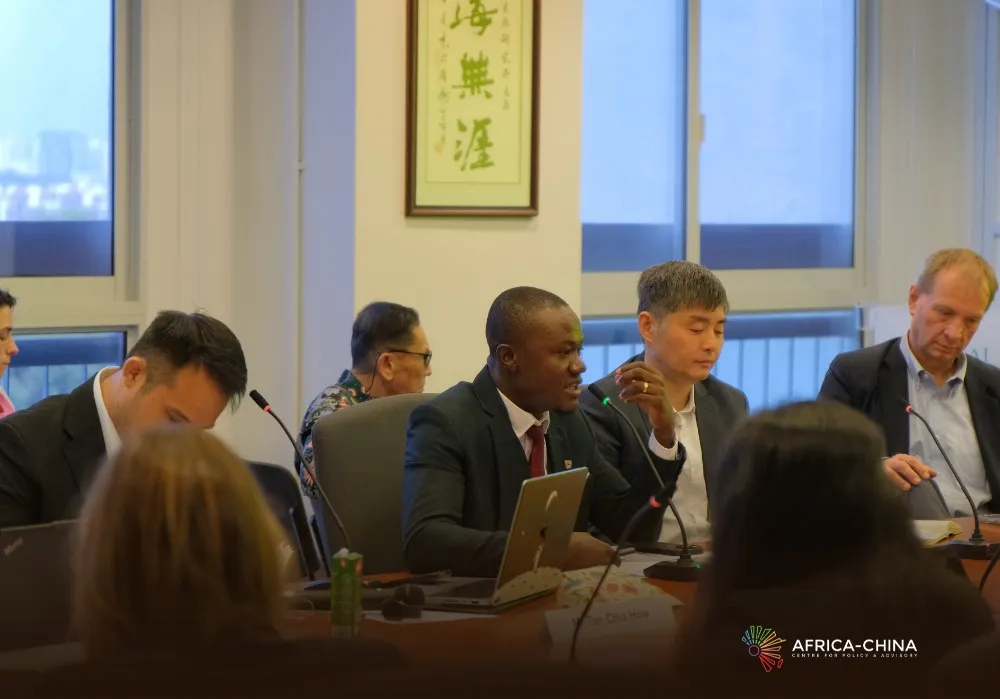
Photo credit: The High Street Journal
African countries were urged to transition from raw material exports to high-value roles within global supply chains. Paul Frimpong of the Africa-China Centre for Policy and Advisory made the call at a Singapore roundtable, noting Africa's current confinement to low-value segments like basic processing. He emphasized the need for engagement in product design, advanced manufacturing, and technology development to foster industrial growth.
Source
The High Street Journal
#["News"#"Africa"#"Economy"#"Geopolitical"#"Ghana Economy"#"Supply Chain"]