Audio By Carbonatix There is a question worth asking carefully as Ghana moves into the implementation phase of the 24-Hour Economy and Accelerated Export Development Programme: who will run it, and with what cognitive equipment? Not the policy direction, which is now approved. Not the political will, which is evident. I mean the practical, daily intelligence required to keep three productive shifts moving in a country that has, until now, run mostly on one. Who schedules the shifts? Who anticipates the equipment failure at 2 a.m. before it disrupts a production run? Who clears the cargo manifest that arrived overnight at Tema? Who prepares the EU compliance documentation so a consignment of cocoa derivatives leaves on Tuesday rather than Friday? Who informs a cooperative in Sefwi what their beans are worth this week in Hamburg? These are the operational questions that will determine whether the 24-Hour Economy becomes a transformational policy or simply an extended-hours policy. The difference between the two outcomes is not effort — Ghanaians are not short of effort. The difference is intelligence capability, in the precise sense of the word: the capacity to make accurate, timely decisions at the speed and volume that round-the-clock production demands. This is where artificial intelligence enters the conversation, and where the National AI Strategy and the 24-Hour Economy Programme begin to look like one project rather than two. A complementary pair of national strategies Ghana now has two ambitious frameworks on the table. The National AI Strategy commits the country to building intelligence capability. The 24-Hour Economy and Accelerated Export Development Programme commit the country to building productive capacity. Each is impressive on its own. Together, they are considerably more powerful and considerably more demanding of the workforce we have yet to build. The 24-Hour Economy is, at its operational core, an intelligence economy in working clothes. Every additional hour of national production multiplies the volume of decisions that must be made, about scheduling, energy, safety, quality, logistics, customs clearance, pricing, market access, and customer service. Human teams, however well-staffed, alone cannot make those decisions at the speed three-shift production requires. Some portion of the cognitive load must be absorbed by intelligent systems. Those systems, in turn, must be directed by trained Ghanaian professionals who know how to use them. That direction, the deliberate, structured guidance of AI tools toward useful, verifiable outputs, is the discipline of prompt engineering. This connection between the two strategies is the case I would like to make. Clarifying what prompt engineering actually is Part of the difficulty in advancing this conversation in Ghana is that prompt engineering is often described, even in serious policy circles, as typing questions into ChatGPT. That description understates the discipline considerably and makes it harder to plan for, budget for, or train at the scale the country requires. A more useful definition is: prompt engineering is the structured design of instructions that guide an intelligent system from general intent to verifiable, context-aware output. It draws on language, logic, domain expertise, ethics, systems thinking, and iterative evaluation. It resembles, in many ways, how a senior lawyer briefs an associate, or how an experienced project manager scopes a deliverable. The professional defines the task, provides the relevant context, sets the constraints, specifies the output format, and verifies the result against reliable sources before acting on it. Consider the difference between the two prompts on the same topic. The first asks an AI tool, "What is agriculture in Ghana?" The second asks it to analyse the constraints facing smallholder maize farmers in the Northern belt under a 24-Hour Economy aggregation model, weigh climate, input cost, market access and extension service variables, propose three intervention designs that integrate night-time processing and cold chain, identify the political risks of each, and produce recommendations in a form a District Chief Executive can act on within the week. Same tool. Very different value. The difference is not in the technology. It is in the human framing. And it points to something important: prompt engineering does not replace professional expertise. It multiplies it. The lawyer who prompts well already understands legal reasoning. The clinician who prompts well already understands diagnostic judgment. The export manager who prompts well already understands AfCFTA rules of origin. AI does not manufacture expertise; it amplifies the expertise that is already present. A workforce that tries to use AI without underlying competence will produce confident, fluent, well-formatted work that is nonetheless unreliable. This is a real risk, and it deserves serious attention as we design training programmes. How prompt engineering supports the 24-Hour Economy in practice The case for treating prompt engineering as core infrastructure of the 24-Hour Economy is best made sector by sector. In manufacturing and agro-processing, intelligent oversight materially changes the economics of running three shifts. AI-supported predictive maintenance helps anticipate equipment failure before it disrupts a night-shift run. Energy optimisation across shifts reduces per-unit costs. Automated shift-handover documentation preserves continuity. AI-assisted quality control reduces defect rates. A factory operating around the clock with these capabilities runs measurably more efficiently than one operating the same hours without them. In ports and logistics, the productivity gains are even clearer. Tema and Takoradi are moving toward 24-hour operations, and the practical constraint is rarely physical capacity. It is decision speed. Risk-based cargo screening, predictive berth scheduling, exception flagging on customs declarations, demurrage management — these are decisions that AI support can deliver in seconds and that, without it, can take hours or days. Across thousands of consignments per month, this is the difference between Ghanaian goods reaching the market on time and losing competitiveness to faster West African ports. In export development, prompt engineering helps Ghanaian SMEs operate at a scale their headcount alone could not support. A founder running a small agro-processing firm in Kumasi cannot personally write proposals at 11 p.m., research non-tariff barriers in Belgium at midnight, and reconcile inventory at 1 a.m. Equipped with serious AI workflows, however, the founder and her team can prepare compliant proposals in the buyer's preferred language, navigate destination-market regulations, and respond to enquiries within the timelines international buyers expect. Many Ghanaian exporters with genuinely competitive products lose deals not because of the products themselves, but because of the cognitive bandwidth available around them. Prompt engineering closes that gap. In agriculture and value addition, prompt engineering supports demand forecasting, real-time price intelligence, traceability documentation that satisfies multiple regulatory regimes, and pest and disease alerts in local languages. The 24-Hour Economy's promise of a strengthened cocoa, shea, cashew, and horticultural export base depends on reliable intelligence flowing from the farm gate to the factory to the freight terminal. AI is the layer that makes that flow possible at scale. In financial services and revenue mobilisation, the GRA, the Bank of Ghana, commercial banks, and district assemblies all gain capabilities from AI-supported fraud detection, scenario modelling, SME underwriting, and revenue analysis. A round-the-clock economy generates round-the-clock financial data, and intelligent systems are essential to keeping pace. In public administration, the Programme Secretariat an
business
Prompt engineering, the 24-Hour Economy, and Ghana’s AI future
MyJoyOnlineBy Abubakar IbrahimFri, 1 May 2026 · 2h ago0 views
Share:
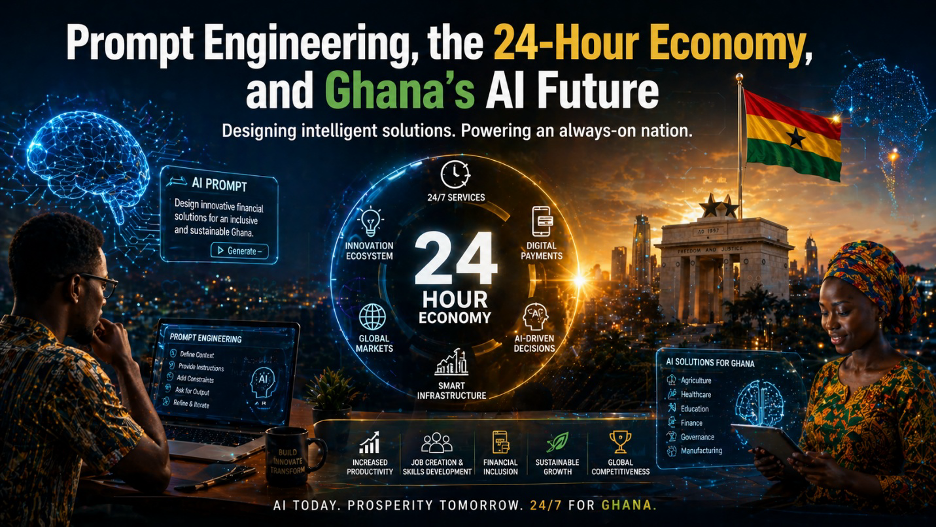
Photo credit: MyJoyOnline
Ghana is implementing a 24-Hour Economy and Accelerated Export Development Programme. The success of this initiative hinges on robust operational intelligence and the capacity for timely, accurate decision-making across continuous shifts. The article suggests that artificial intelligence, particularly prompt engineering, will be crucial for managing these demands, linking Ghana's National AI Strategy with the 24-Hour Economy as complementary national goals.
Source
MyJoyOnline
#["Opinion"#"24-hour economy"#"Prompt engineering"]