The cedi today is like a patient who has just left the emergency room, no longer in critical condition, but not fully recovered either. It is stable enough to walk, but not strong enough to run. That is the most honest way to read its current position against the US dollar. As of April 23, 2026, the exchange rate sits around GHS 11.10 to $1, marking a 2.99% depreciation over the past six months. On the surface, that looks controlled. But the journey to this point tells a more revealing story, one of sharp intervention, brief recovery, and a gradual return to underlying pressure. The past six months have been anything but smooth. The cedi weakened steadily toward GHS 11.40 in late 2025, before a sudden correction in January 2026 pulled it down to nearly GHS 10.40. That kind of move does not happen naturally. It points to deliberate action, tight policy, central bank intervention, and improved forex inflows. For a moment, the cedi looked like it had turned a corner. Source: Google Finance It hadn’t. From February through April, the currency quietly lost ground again, climbing back above GHS 11.00. No panic, no headlines, just a steady reversal. And that is often more telling than a sharp drop. It suggests that the underlying pressures never really left; they were only managed. READ ALSO Towards a Successful Diaspora Bonds Issuance: 9 Strategic Recommendations for Policy Direction A Quiet Ownership Revolution: Ghanaian Firms Reclaiming the Economy Through the Stock Market Energy Commission Tightens Electrical Safety, Certifies New Batch of Skilled Electricians What we are seeing now is not strength, it is control. The Bank of Ghana appears to have reduced volatility, but stability alone is not the same as resilience. Demand for dollars remains high, exports remain narrow, and external obligations continue to weigh on the system. The cedi is being supported, not yet sustained. For businesses, this matters. The absence of sharp swings brings some relief, pricing is more predictable, planning is easier. But the slow depreciation still bites. Import costs rise quietly, fuel follows, and margins tighten over time. It is not a shock to the system, it is a steady squeeze. So where does this leave us? The cedi is at a delicate point. It could hold around current levels if inflows remain strong. It could continue to weaken gradually as structural issues persist. Or it could swing again if confidence shifts. The direction will depend less on short-term intervention and more on long-term discipline, how well Ghana manages its finances, grows exports, and builds credibility. Holding the cedi at GHS 11.10 is not the win. The real win is building an economy where the cedi does not need rescuing every few months. Because in the end, a currency is not defended into strength, it grows into it. Share this: Share on X (Opens in new window) X Share on Facebook (Opens in new window) Facebook Like this:Like Loading... Related
business
Reading the Cedi: Signs of Stability, Signals to Watch
The High Street JournalBy The High Street JournalThu, 23 Apr 2026 · 1h ago0 views
Share:
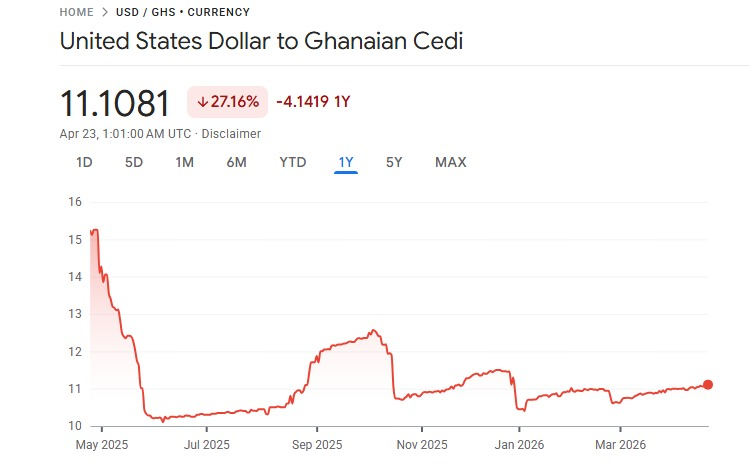
Photo credit: The High Street Journal
As of April 23, 2026, the cedi trades at GHS 11.10 to $1, reflecting a 2.99% depreciation over the past six months. The currency saw a sharp correction in January 2026, dropping to GHS 10.40 from GHS 11.40 in late 2025, likely due to intervention. However, it has since quietly lost ground, returning above GHS 11.00 by April.
Source
The High Street Journal
#["Business & Economy"#"Markets"#"Cedi"#"Stability"]