There is a growing wave of public opposition emerging against plans by Gold Fields to secure a 20-year extension of the lease for the Tarkwa Mine, with many Ghanaians insisting that the country must take greater control of its mineral resources. This public uproar follows remarks by Mike Fraser, who revealed that he was in Ghana to engage the government over a possible long-term extension of the mining company’s operations at Tarkwa. But across social media platforms, many Ghanaians expressed frustration, skepticism, and growing resource-nationalist sentiments, questioning whether decades of foreign-led mining have translated into meaningful development for local communities. A dominant sentiment running through the reactions was the belief that Ghanaian companies and investors should now take over the mine instead of renewing the lease for another two decades. “We can’t extend for 20 years,” one commenter wrote. “Gather the rich guys in Ghana — Ibrahim Mahama, Kojo Poku, Akwasi Oppong, and others, let them mine for Ghana and build billionaires here.” READ ALSO Gov’t Positions Poultry as Strategic Growth Sector But Can the New Master Plan Rescue a Struggling Industry? Locked Out of Opportunities: Systemic Barriers Stall Entrepreneurs Living with Disabilities in Ghana Ghana, UAE Advance Energy Investment Push, Target LNG and Storage Expansion Others proposed the formation of a Ghanaian mining consortium involving local mining firms and government participation. According to many netizens, Ghana has reached a stage where indigenous ownership and control of strategic natural resources should become a national priority. “This lease should not be extended,” another user argued. “Let’s form a local mining consortium. The government can own part of it, and Ghanaian firms take the rest. We can do it.” Some reactions also reflected deep concerns about whether communities surrounding Tarkwa have truly benefited from the mine despite decades of extraction. Several commenters questioned the visible developmental footprint of Gold Fields in Tarkwa after years of operation. “What monumental development have they given Tarkwa after 30 years of mining?” one user asked, echoing a sentiment repeated by many others online. Another commenter questioned the broader economic returns Ghana receives from its mineral wealth, especially considering the scale of production from the country. “Twenty-five percent of your global production comes from Ghana. What percentage does Ghana get?” the commenter wrote. For many critics, the issue goes beyond a lease renewal. It reflects a broader national conversation about ownership, value retention, and whether Ghana is obtaining enough long-term benefits from multinational mining companies operating in the country. Some commenters also expressed concern that foreign mining companies continue to dominate a sector they believe should increasingly empower local entrepreneurs, engineers, and investors. Others pushed for even stronger state involvement, arguing that Ghana should eventually move toward state-led mining operations. “I believe all should be state mining companies from now,” one commenter stated. There were also nationalist undertones in some reactions, with a few users insisting that Gold Fields should focus operations in its home country, South Africa, rather than seek another long-term extension in Ghana. Still, not all the reactions were entirely dismissive of the company’s presence. A minority of commenters defended Gold Fields, citing infrastructure projects and employment opportunities linked to the company’s operations in Tarkwa over the years. Some pointed to roads, sports infrastructure, and local jobs as evidence that the mining giant has contributed to the municipality’s growth. However, even among those acknowledging such contributions, there remained a broader demand for a new model of mining that gives Ghanaians a larger stake in ownership, profits, and decision-making. For now, the online reactions reveal a shifting public mood around natural resource governance in Ghana. Increasingly, many citizens appear less interested in the mere presence of foreign investment and more concerned about how much long-term value stays within the country and directly improves local livelihoods. As discussions over the future of the Tarkwa lease continue, the public debate is rapidly evolving into a larger national conversation about economic sovereignty and local participation. Share this: Share on X (Opens in new window) X Share on Facebook (Opens in new window) Facebook Like this:Like Loading… Related
politics
Sections of Ghanaians Strongly Oppose Gold Fields’ Quest to Extend Lease of Tarkwa Mine by 20 Yrs
The High Street JournalBy Fredrick Addai KwartengThu, 7 May 2026 · 1h ago0 views
Share:
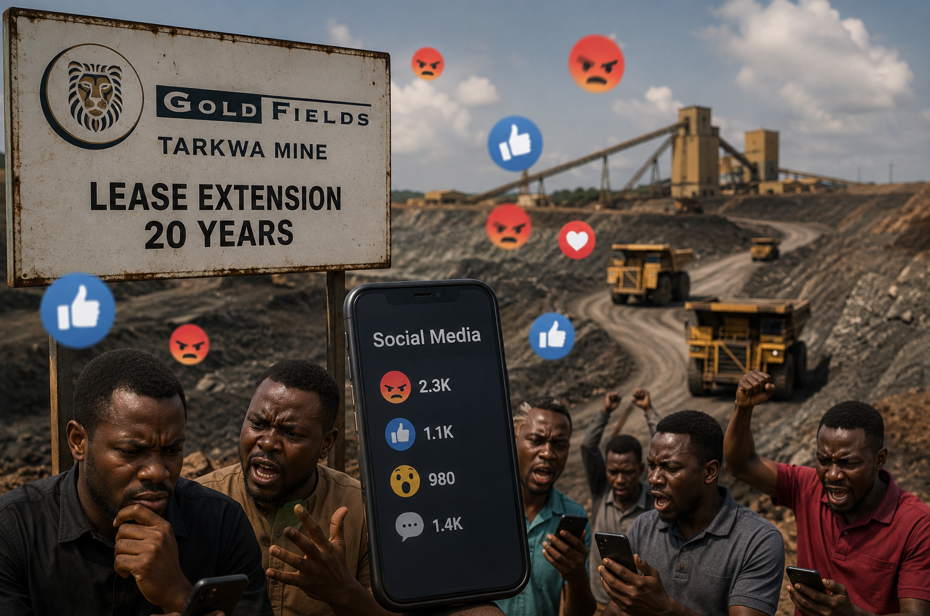
Photo credit: The High Street Journal
Ghanaians are strongly opposing Gold Fields' proposed 20-year lease extension for its Tarkwa Mine. Public sentiment, expressed across social media, advocates for greater national control and local ownership of mineral resources. Many believe Ghanaian companies and investors should manage the mine instead of renewing the foreign company's lease, questioning the development impact of past foreign-led operations.
Source
The High Street Journal
#["Business & Economy"#"Gold Fields"#"Mike Fraser"#"Tarkwa Mines"]