On a typical morning in Accra, the rhythm of work begins long before sunrise. From trotro stations to market stalls and office cubicles, millions of Ghanaians step into another day of labour with a quiet calculation at the back of their minds. It is not about profit or savings. It is about survival. The arithmetic does not add up, yet somehow, it continues to work. This is the paradox that defines the modern Ghanaian worker, a reality that has increasingly drawn comparisons to magic. At the heart of this paradox lies a stark mismatch between income and expenditure. According to data from the Ghana Statistical Service, a significant proportion of workers, particularly in the informal sector, earn monthly incomes that fall below 1,000 Ghana cedis. Even within the formal sector, many entry-level salaries hover around 700 to 1,200 Ghana cedis. Yet, basic monthly expenses in urban centres such as Accra often exceed 2,000 Ghana cedis when transport, rent, food, utilities, and communication costs are combined. The numbers become even more striking when placed alongside the statutory wage floor. Ghana’s national daily minimum wage currently stands at 21.77 Ghana cedis, set by the National Tripartite Committee and effective from January 2026. This translates to roughly 580 to 650 Ghana cedis per month, depending on the number of working days, an amount that falls significantly below the estimated cost of living in major cities. In effect, the legally permissible baseline income in the country is still far short of what is required for a basic standard of living. The question that emerges is both simple and unsettling. How do workers bridge the gap between what they earn and what they spend? Part of the answer lies in the structure of Ghana’s economy itself. The International Labour Organisation has consistently highlighted that over 80 percent of Ghana’s workforce operates within the informal sector, where incomes are unstable and social protections are minimal. In such an environment, financial planning becomes less about long-term security and more about daily improvisation. READ ALSO Egg Export Disruptions Deepen Glut, Leave Ghana’s Poultry Farmers Counting Losses Too Far, Too Formal, Too Difficult: Why Smallholder Farmers Say ADB Is Failing Them Profit Pressures, Rigid Pricing Deepen Ghana’s Egg Glut, Farmers Say Households rely heavily on what economists describe as coping mechanisms. These include borrowing from friends and family, purchasing goods on credit, reducing meal portions, or postponing essential expenses such as healthcare. The World Bank, in its assessments of living conditions in Sub-Saharan Africa, notes that many urban households survive through a combination of multiple income streams and informal support networks rather than a single stable salary. Inflation has further complicated the equation. Ghana has experienced sustained increases in the cost of living in recent years, particularly in food and transport. Data from the Bank of Ghana shows that inflationary pressures have eroded purchasing power, meaning that even when nominal wages remain unchanged, their real value declines. In practical terms, the same 700 Ghana cedis that could sustain a worker a few years ago now covers far less. For many workers, the gap between income and expenditure is quietly filled by an expanding web of side hustles that stretch beyond the traditional workday. From ride-hailing after office hours to selling clothes online, baking on weekends, mobile money vending, or small-scale farming, these secondary income streams have become essential rather than optional. What was once considered extra income is now a lifeline. The rise of this parallel economy reflects both ingenuity and necessity, as workers diversify their earnings to survive an economic reality that a single paycheck can no longer sustain. In some cases, this pressure spills into troubling territory. Labour analysts and governance reports have long warned that persistently low wages can create incentives for workplace misconduct. Petty theft of company materials, manipulation of accounts, and informal “top-ups” in cash handling roles have been cited in broader discussions on corruption risks in low-income environments. While not representative of the majority of workers, these practices reflect a deeper systemic strain where survival competes with ethics. Experts argue that when compensation consistently falls below living standards, the boundary between coping and compromise can become dangerously blurred. This erosion of purchasing power has been acknowledged at the highest levels of labour advocacy. The Trades Union Congress of Ghana has repeatedly raised concerns about the gap between wages and living costs. In its 2025 May Day statements, the Congress emphasised that many workers are unable to meet basic needs despite being fully employed, calling for adjustments in wages that reflect economic realities. Another dimension of this “magic” is the cultural and social fabric of Ghanaian life. Financial responsibility often extends beyond the individual. A single income may support extended family members, contribute to community obligations, and respond to emergencies that arise without warning. These social expectations, while rooted in solidarity, place additional pressure on already stretched incomes. Urbanisation also plays a role. As more people migrate to cities in search of opportunity, the cost of accommodation has surged. Rent advances, often requiring one to two years of payment upfront, force workers into long-term financial commitments that far exceed their monthly earnings. This creates a cycle where a significant portion of income is either pre-allocated or borrowed against future earnings. What emerges from these layers is not magic in the literal sense, but a complex system of survival driven by resilience, sacrifice, and constant adjustment. The Ghanaian worker stretches every cedi through strategies that are as creative as they are precarious. Meals are skipped so children can eat. Transport fares are negotiated. Side hustles emerge after long workdays. Each decision is a quiet act of balancing an equation that refuses to balance. As Ghana marks International Workers’ Day, the celebration of labour takes on a deeper meaning. Beyond the parades and speeches lies a pressing national conversation about the sustainability of this “magic.” The ability of workers to continually absorb economic shocks without structural change raises important questions about wage policies, social protection systems, and the future of work in Ghana. For now, the illusion holds. The worker earns 700 and spends 2,000, not because the numbers align, but because survival demands it. Beneath this illusion is not trickery, but a testament to endurance. The real question is how long this performance can continue before the system itself demands a different kind of transformation. Share this: Share on X (Opens in new window) X Share on Facebook (Opens in new window) Facebook Like this:Like Loading... Related
business
The Ghanaian Worker’s Magic: How Low Incomes Fund Higher Living Costs
The High Street JournalBy Makida El HusseiniFri, 1 May 2026 · 4h ago0 views
Share:
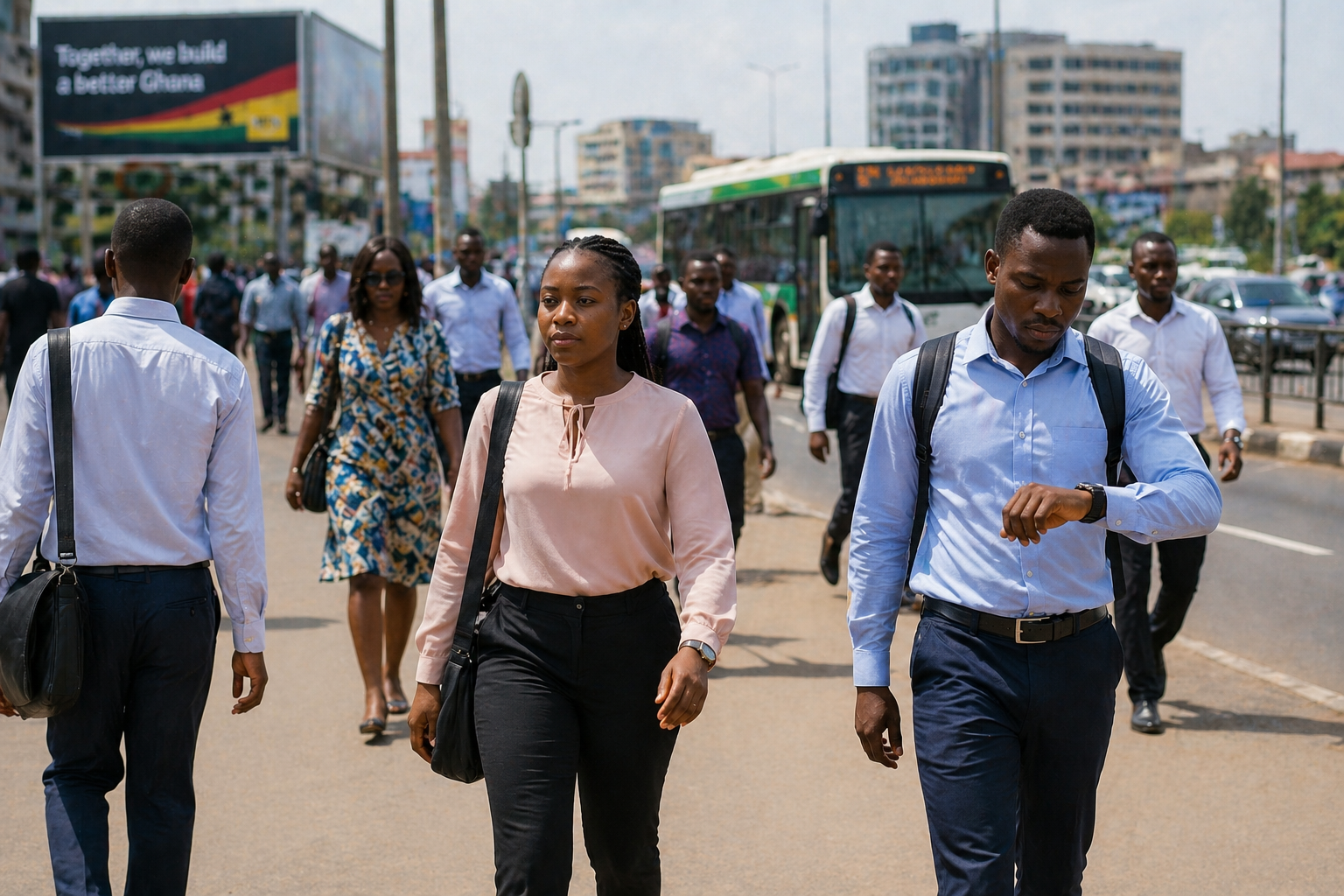
Photo credit: The High Street Journal
Ghanaian workers face a paradox where low incomes fund higher living costs. Many earn below 1,000 Ghana cedis monthly, while basic urban expenses often exceed 2,000 Ghana cedis. The national daily minimum wage of 21.77 Ghana cedis (effective 2026) translates to 580-650 Ghana cedis monthly, falling significantly below estimated living costs.
Source
The High Street Journal
#["Business & Economy"#"Formal Sector"#"Income"#"Informal Sector"#"Labour"#"Top Story"]