An interpretation of the Bank of Ghana’s 2025 financial loss is challenging the dominant public criticism of the development, reinforcing the Central Bank’s defense that the loss was a necessary evil. IMANI Africa’s analyst, Sitsofe Mensah, also insists the numbers reflect deliberate economic defence, not waste or mismanagement. According to the IMANI analyst, a closer look at the central bank’s accounts shows that the bulk of the losses stemmed from intentional policy actions aimed at protecting the economy from runaway inflation and currency instability. “This was not money lost to administrative bloat, corruption, or missing funds. The vast majority of the 2025 loss was an active, deliberate policy expense,” he emphasized. Sitsofe Mensah At the centre of this argument is a single figure of GH¢16.73 billion spent on Open Market Operations (OMO) in 2025. READ ALSO Outsourcing Of Government Contracts Threatens Local Garment Industry – McKenzie CEO Sunyani Garment Firm Seeks Government Contracts To Create 2,000 Jobs If The Economic Stability Does Not Lead to Increased Productivity, the BoG Loss Would Have Been in Vain He explains that in practical terms, OMO is how the central bank removes excess cash from the economy. When too much money is circulating, prices tend to rise rapidly, eroding the purchasing power of households. To prevent this, the Bank of Ghana issues its own short-term instruments and pays commercial banks to hold onto their cash instead of lending it out. Sitsofe Mensah likens the situation to controlling a flood, where the excess running water must be drained and kept in reservoir which cost money. Without intervention, excess liquidity in the banking system would spill into the broader economy, chasing limited goods and foreign currency. The likely outcome would be a sharp depreciation of the cedi, rising inflation, and a significant decline in real incomes. “Think of excess liquidity like a massive flood heading toward a village. The BoG is the government, and the commercial banks own massive, empty reservoirs. The BoG pays the commercial banks a heavy fee—the GH¢16.73 billion—to open their reservoirs and trap the floodwaters,” the analyst narrated. He added, “Yes, the reservoir owners get rich from the fee. But if the BoG didn’t pay them to lock that money in the central vault, the banks would inject it into the public economy. The floodwaters (excess cash) would chase a limited supply of dollars and goods, washing away the entire village by cratering the cedi’s value.” For him, the cost may look high, but the alternative would have been far more damaging. Beyond OMO, the central bank also absorbed GH¢5.47 billion in foreign exchange-related losses and GH¢9.05 billion tied to gold transactions, further evidence, analysts say, of the high cost of stabilising a fragile economy in a turbulent global environment. By aggressively mopping up liquidity, the Bank effectively slowed the pace at which money circulated in the economy. This helped ease pressure on prices and the exchange rate, outcomes that directly affect everyday life, from food prices to transport costs. Analysts say, for households, the impact is subtle but significant. Lower inflation means incomes stretch further, savings retain value, and businesses can plan with greater certainty. In that sense, the central bank’s losses can be viewed as a form of economic insurance, paid upfront to avoid deeper hardship later. BoG Governor Dr. Johnson Pandit Asiama Rather than asking why the Bank made losses, the IMANI analyst suggests attention should shift to what those losses prevented. In a period where inflation could easily have spiralled, and the currency came under severe strain, the central bank chose to act decisively, even at a financial cost. Share this: Share on X (Opens in new window) X Share on Facebook (Opens in new window) Facebook Like this:Like Loading... Related
business
BoG’s GH¢16B OMO Loss Not out of Mismanagement, but Protective Measure to Shield Economy – Analyst
The High Street JournalBy Fredrick Addai KwartengSun, 3 May 2026 · 1h ago0 views
Share:
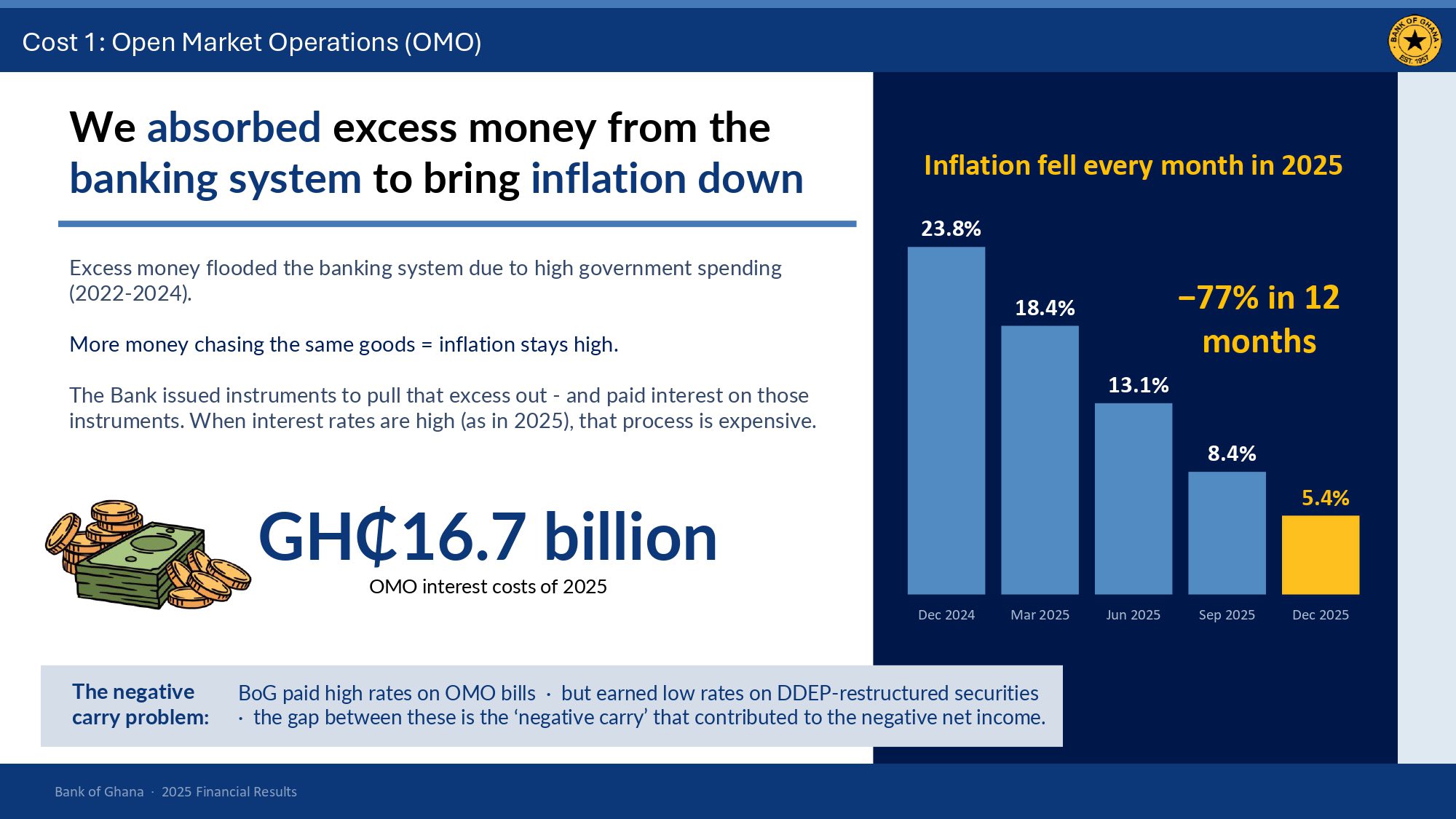
Photo credit: The High Street Journal
An IMANI Africa analyst asserts the Bank of Ghana's GH¢16 billion loss in 2025 resulted from Open Market Operations (OMO), not mismanagement. The analyst, Sitsofe Mensah, states these were deliberate policy actions to protect the economy from inflation and currency instability by removing excess cash. The bulk of the loss stemmed from these intentional economic defense measures.
Source
The High Street Journal
#["Business & Economy"#"Bank of Ghana"#"John Sitsofe Mensah"#"OMO"]